Flight simulator for
flight training benefits
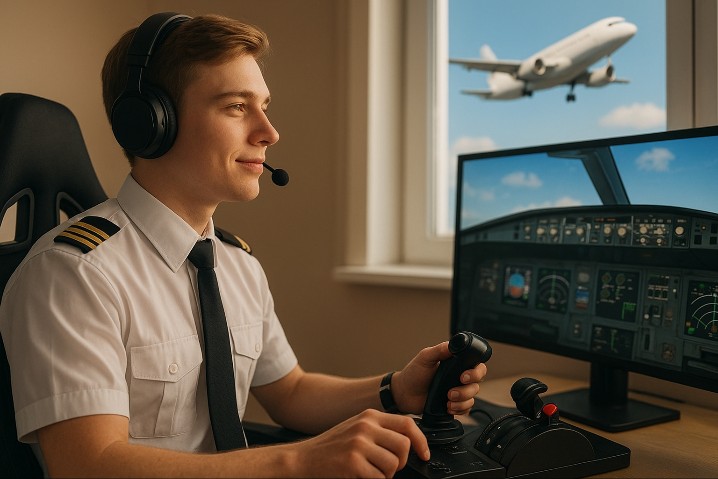
Want to save money your pilot certificates? Get yourself a flight simulator for flight training.
Flight simulators have become an essential tool in modern pilot training, allowing students to
- refine their skills
- enhance situational awareness and
- prepare for real-world flying in a safe and cost-effective environment
In short: they save you money. They also get you to perform better.
Using a flight simulator offers several key benefits: it allows pilots to prepare for lessons before heading to the airport, helps develop and refine the pilot scan, and makes flying more automatic so that mental capacity can be dedicated to other critical tasks such as communication and decision-making.
Preparing for Each Lesson Before Flight
One of the greatest advantages of your flight simulator for flight training is the ability to prepare for each flight lesson before ever stepping into the cockpit.
In real-world flight training, time in the aircraft is limited and expensive—often costing between $150 and $300 per hour (if you are luck) depending on the aircraft and instructor.
Because of this, it’s important for students to use their time efficiently. If you're having to repeat lessons your costs will go up dramatically.
Flight simulators allows you to practice lesson material beforehand and even after every lesson. This way not only will you be better prepared but you will perform better too (your instructor will be impressed!)
So where to begin?
Programs such as X-Plane 12 and Microsoft Flight Simulator 2024 are good. They provide incredibly detailed and realistic representations of real-world aircraft, airports, and weather conditions.
These simulators can be run on most gaming computers and are relatively affordable compared to the cost of flight time. X-Plane 12 costs around $60, while Microsoft Flight Simulator 2024 costs about $70, depending on the edition.
Both programs feature highly accurate flight dynamics and cockpit controls, allowing students to learn normal and emergency procedures, practice checklists, and become familiar with cockpit layouts before they fly the real airplane.
By using these simulators, student pilots can rehearse maneuvers such as stalls, steep turns, normal takeoffs, normal landings, traffic pattern work, navigation, etc...you can even go online with this atc simulator too!
This not only improves retention of procedures but also builds confidence.
When a student steps into the actual aircraft, they already have muscle memory for switch locations, basic control movements, and checklist flow. This kind of preparation translates directly into a smoother and more efficient flight lesson.
Training and Refining the Pilot Scan
Another critical skill that simulators help develop is your pilot scan. This alone is worth it because you are training yourself to look at all your instruments at the same time.
Flight simulators provide a controlled setting where pilots can focus on building their instrument and visual scanning habits without the distractions or pressures of actual flight.
For an even more immersive experience, adding virtual reality (VR) to simulator training can dramatically enhance realism. Using a Meta Quest 3 headset (approximately $500) connected to a capable PC allows students to experience a true three-dimensional cockpit environment. With VR, a pilot can look around the cockpit naturally, lean toward instruments, and visually check traffic or landmarks outside the window.
"A flight simulator like that for flight training is expensive! " I hear you say. Again...this is a much cheaper (and enjoyable) option to having to repeat lessons...Speaking of putting things on repeat...
Making Flying More Automatic
Another major benefit of a flight simulator for flight training is the development of “automaticity” — the ability to perform basic flying tasks without conscious thought. In aviation, this is critical because pilots must divide their attention among flying, navigating, communicating, and managing systems.
The more automatic the basic control of the aircraft becomes, the more mental bandwidth is available for higher-level tasks such as radio communication, decision-making, and situational analysis.
Simulators allow students to practice procedures repeatedly until they become second nature. For instance, practicing takeoff and climb checklists dozens of times in a simulator costs nothing but time, whereas doing so in a real aircraft would quickly become expensive.
This repetition helps students internalize flows and checklists so that, during an actual flight, they can execute them smoothly and confidently.
"This is all great but I really...really...REALLY can't afford it!" I hear you say. Well..that's why there's always "chair flying."
The Value of Chair Flying
Finally, there’s one form of simulation that is completely free: chair flying. Chair flying involves sitting in a chair, mentally visualizing the cockpit, and going through the motions of each procedure—speaking checklists aloud, moving one’s hands as if manipulating controls, and visualizing flight maneuvers.
This mental rehearsal technique has long been used by both student pilots and airline captains because it strengthens procedural memory and improves confidence. Although it lacks the realism of a simulator, chair flying is incredibly effective and can be done anywhere, at any time.
Flight simulator for
flight training conclusion
Flight simulators have revolutionized pilot training by providing affordable, realistic, and safe environments for students to learn and refine their flying skills. Whether using a home-based program like X-Plane or Microsoft Flight Simulator, adding a VR headset like the Quest 3 for immersive realism, investing in a professional-grade Redbird simulator, or simply practicing chair flying, each method contributes to a pilot’s growth.
Simulators help students prepare for lessons, improve their pilot scan, and make flying tasks more automatic—ultimately producing safer, more proficient aviators. In today’s world, where both safety and efficiency are paramount, flight simulators are not just a helpful supplement to flight training—they are an essential component of it.
get aviation english support
Want support with your private pilot flight training studies or aviation English assistance? Then send me a message and we can take a look at what can help you the most.